Showing posts with label spinning. Show all posts

Sunday, November 13, 2016

Podcast Episode 2 - WPI Meaning and PayItForward


Episode 2 is up.  We discuss how to measure the thickness of your handspan yarn using WPI (Wraps Per Inch) as well as the amazing, generous giveaways from the yarn and fiber community with #payitforward


As promised my WPI range. . . . I will also put this in a PDF in the upcoming week and add it to my main website along with the translations of the new US labeling system and common needle/crochet hooks and gauge for each weight of yarn:
  • Bulky (less than 8)
  • Aran 8-10
  • Worsted 10-12
  • DK 12-18
  • Sport 18-24
  • Fingering/Sock 24-30
  • Lace 30-40 

Here is the pattern link to the hat I will be spinning for in the next coming weeks: 

Don't forget to follow us on Instagram @almapark or Facebook for a chance to enter our #AlmaParkpaysitforward giveaway. 


Friday, July 10, 2015

Series (Installment 3 - Icelandic Wool): Spinning my way through the Fleece & Fiber Sourcebook

This is the third post in the Series.  Follow the links below to view the 1st and 2nd posts in this series.

Installment 1 - Huacaya Alpaca
Installment 2 - Corriedale Wool

Icelandic Wool 

"This breed originated in Iceland and is hardy and adapted to harsh, changeable climate and marginal pasture and browse conditions. Ewes are prolific, good milkers and possess exceptional longevity. The Icelandic has historically been a meat breed, but is also a noted source of wool for lopi yarn. Fleece colors can be white, tan, brown, gray or black. The breed is both polled and horned with both sexes capable of horn growth." 1
  • Fiber Characteristics - Icelandic fleece are dual-coated.  There is a long outer coat called the tog and a downy soft undercoat called the thel.  The can be separated or spun together.  Icelandic fleece is a very versatile fiber and  the tog/thel combo can be spun into a single ply lopi type yarn (although a true lopi is actually slightly twisted roving) , 2-ply tog/thel combo or can be separated.  The tog is long and strong and can be spun for warp or a variety of uses.  The soft thel undercoat can be spun by itself or blended with fine fibers such as alpaca to make a next to skin soft yarn.  Micron of the tog (27-30) with an average staple of 4-18 inches, micron of the thel (19-22)  with an average staple of 2 - 4 inches. 1
  • Grades  - There are not typical grades like that of alpaca, but from my experience, lamb and hoggett fleece are softer than adult as one might expect.  Also on a lamb/hoggett fleece, the tog and the thel are closer in micron and the resulting yarn is softer.  As a sheep ages, it seems that the tog gets coarser, much like alpaca fiber. 
  • Blending  - The thel is wonderful blended with other soft fibers like alpaca for next to skin wear! Blending the tog and the thel together and spinning it is very common and makes a wonderful strong yarn for outerwear, but on young fleeces, the tog and thel can be blended together and still be next to skin soft.    
  • Prep Work   - most often, I like to card this fiber into batts or rolags to spin, but Icelandic can be spun from the lock as well.  It is best if you feed the fiber cut side into the carder. If I am going to separate the tog and thel, I like to do so before washing, but it can also be accomplished after.  I separate by hand, but you can also use a single pitch comb if you prefer.  Do not use double pitch combs as all of that beautiful thel fiber will end up as waste.   Careful washing is VERY important for this wool more so than other wools as Icelandic fiber is some of the best fiber on earth to felt with.  I have even found that the fiber in my draft hand will felt from the moisture in my hand, so I take only a small amount to hold at any one time.  Any agitation in the wash and you will find yourself having a solid mass rather than fiber to spin.  It usually requires only one wash in hot water to remove the lanolin and 2 hot rinses as they are not a really lanolin heavy.  My experience is a loss of 15% or less to lanolin.  (I will be doing a video of tog/thel separation in the near future and will update this with a link
  • Spinning Ease -  When well prepared, Icelandic spins like a dream.  I have seen many folks afraid of this fiber on discussion groups, but for me it is one of the most fun fibers to spin.  It is so versatile!  I would not recommend it for a true beginner, but after some experience conquering other wools and wool prep, I say jump in and enjoy.  True traditional Icelandic Lopi (from native Iceland) is defined as a "slightly twisted" and is very light and airy and is more "roving" like.  True Lopi should not be confused with a "single", but many people use the two interchangeably.  I have never spun true Lopi, but I do have a single pictured below. 

    "The machine-carded roving is produced in disc-shaped rolls. This is the original unspun lopi first used for knitting c.1920's. More recently, lightly spun lopi yarn in different thicknesses has become available." 2
  • Dye Uptake :  you can see from the pic below that Icelandic takes dye wonderfully.  Healthy fiber (from healthy animals), like the ones I have had the pleasure of working with has a natural sheen and beauty and produces wonderful jewel-toned colors.  
  • Setting : Wet setting is accomplished like any other wool yarn.  Submerse in hot water, no agitation and hang to dry.  With "Lopi" style yarn, I do a tiny bit of fulling by a submersion in hot water followed by a submersion in cold water, no agitation and then some good  thwacks (4 - 5)  and hang to dry.  I also let my "Lopi" yarn sit on the bobbins for at least 48 hours to "relax" before skeining. It makes a world of difference! 
  • Knitting : Icelandic is wonderful to knit with and can be used for next to skin garments for all but the most sensitive of people.  It is durable and can be used for almost any project.   The lamb/hoggett fleeces are very soft if not overspun, and can be enjoyed next to skin by almost anyone, even if not separated.   


    Some of my work with Icelandic wool.  I spin a lot of Icelandic, so I chose this selection to show the versatility of Icelandic.

    Batts blending both tog and thel.  Dyed a raspberry colorway.
    A lovely soft natural copper color to the right.  Fiber from my friend Tracy. 
    Tog and thel blended together into a 2 ply yarn.  Fiber from my friend Connie
    Tog and thel blended together into a 2 ply yarn with guineau
    feathers incorporated.  Fiber from my friend Connie
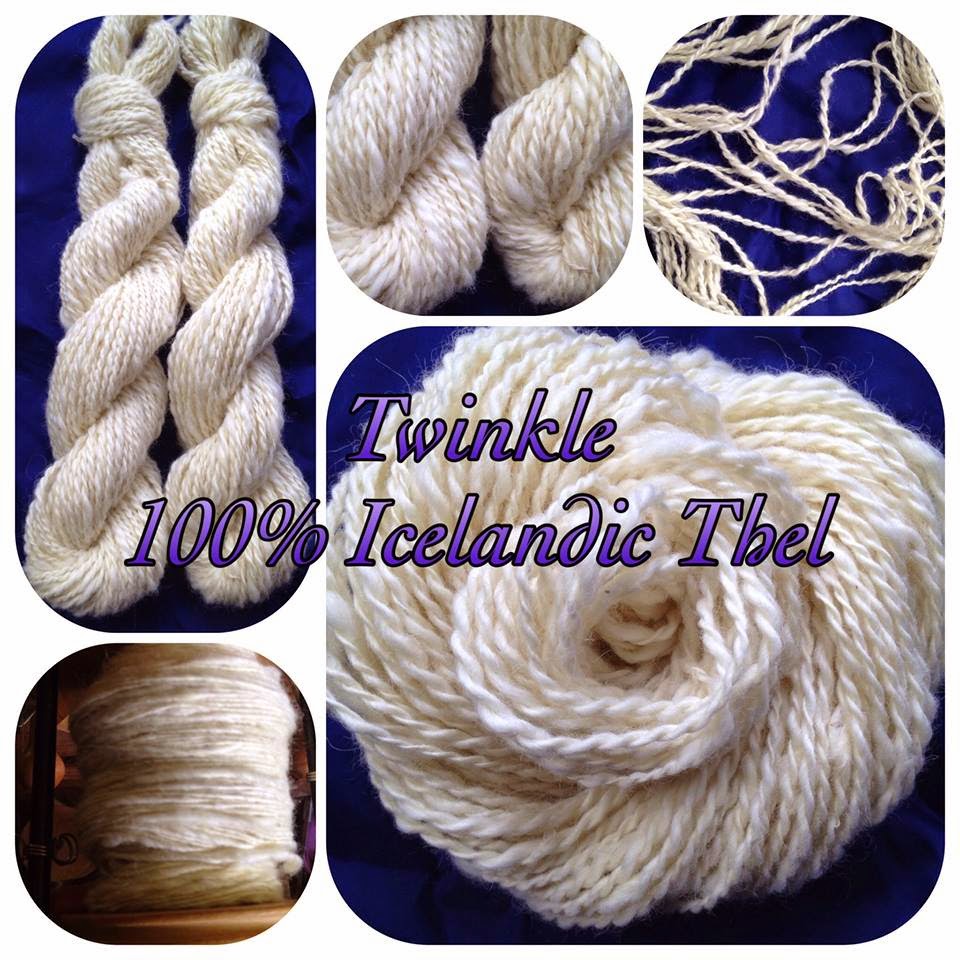
    Thel only.  So shiny and soft - 2 ply.  Fiber from my friend Connie.

    Tog only.  Strong and tightly spun 3 ply because of it's intended
    use.  Fiber from my friend Connie.

    Tog and thel blended together into a 2 ply yarn.  Fiber from my friend Connie.

    Tog and thel blended together and then plied with a cut up
    silk scarf.  
    Fiber from my friend Connie. 

    Untitled
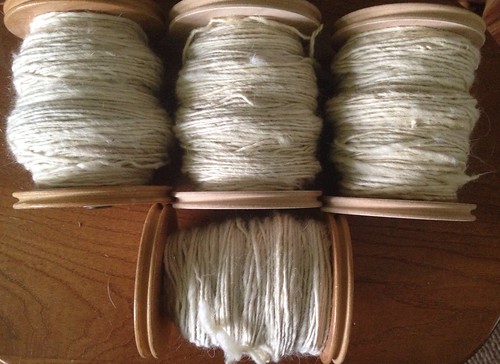
    "Lopi"style yarn still on the bobbins - fiber
     from my friend Deb - Sheep "Agnus Dei" 
    Finished well "relaxed" Lopi Style yarn.
    Fiber from my friend Deb - sheep "Astrid" 


    1 - https://www.sheepusa.org/ResearchEducation_Literature_BreedDirectory
    2 - http://en.wikipedia.org/wiki/Lopi 


    Saturday, June 13, 2015

    Tour de Fleece 2015 (Team Spin a Pound, Get a Pound™)

    I am so excited that Tour de Fleece (July 4 - July 26)  is around the corner!!  This year I am co-captain with some friends of the Spin a Pound, Get a Pound™ group.

    I am in the process of planning out what I will be spinning and will be posting pictures :)  A few weeks left to prep, then it's off to the races !!

    Here's out official team graphic:


    Friday, May 15, 2015

    New colorways - Spinning batt and Yarn - Caribbean Coral

    A couple of fun colorways just in time for summer!! Daydream away with these colorful island fibers. Even if you can't go to the caribbean, you can have some in your life. You can go right to the product page by clicking "buy now" buttons or head on over to the The Yarn Shop at Alma Park


    Caribbean Coral Textured Batt - 2 oz

    Caribbean Coral Fingering Yarn in Donegal base

    Friday, February 21, 2014

    Series (Installment 2 - Corriedale Wool): Spinning my way through the Fleece & Fiber Sourcebook


    Corriedale Wool 


  • Fiber Characteristics - Corriedale wool is readily available in commercial top and normally is seen in the preparation in either white or brown.  Commercial top is typically in the micron range of 26-27 which is a spinning count of 56-58s.  For those of you unfamiliar with what spinning count actually means . . .  "It is a system that originated in the 19th century (along with mechanized spinning equipment). It is the number of hanks of yarn, each 560 yards in length, that it is possible to spin from one pound of clean wool. The finer the wool fiber, the more hanks (greater length, thinner yarn) that can be obtained from one pound." (1)  So the lower the micron, the finer the fiber and more hanks per pound (higher spinning count).  

  • "The Corriedale is the oldest of all the crossbred wool breeds, a Merino-Lincoln cross developed in Australia and New Zealand and first brought to the United States in 1914. Corriedales are a dual-purpose sheep with good meat and wool.
    Their dense fleece is medium-fine and high yielding, with good length and softness, somewhat between medium wool and long wool. It is favored by hand spinners. Corriedale lambs produce good quality carcasses and have a high pelt value.
    Breed categories: medium wool, dual-purpose" (2)
    • Grades  - Like Alpaca, Corriedale fleece can have a range of micron.  This can vary from sheep to sheep, farm to farm.  It is based on genetics, environment and age, much like alpacas.  Published ranges of micron are 22 - 34 microns (1), and 25 - 31 (3).  In the commercial top market, there seems to be a consistent 26-27 microns.  
    This medium wool with the  range of micron 26-27 is still next to skin soft but is also durable and can be used for almost any project.  Corriedale (like most wools) does not have to be blended to make it "workable" for a particular project.  100% Corriedale is good all by itself, retains it shape and is easy to care for.  Having said that, if you are going to make socks, I would still blend with a bit of nylon for durability.  
    • Blending  - Corriedale blends well with other fibers like silk, nylon and alpaca. . . if using alpaca or another wool - make sure the micron is of a similar grade to the Corriedale to make the yarn as consistent as possible
    Organic Brown NZ Corriedale blended with Tussah and Soffsilk™
    Prepped from commercially prepared top -  For Sale Here
    • Prep Work   - When working from raw wool, washing methods are important.  While "spinning in the grease" can be accomplished with Corriedale, but it does have a good amount of lanolin (I could not find % stats) and like any wool, not washing completely and then storing can make for a "sticky" fleece that will be difficult to comb, card or spin.  So if you are not going to work with it right away, wash out the lanolin completely before storing.  Carding a sticky fleece will produce neps and noils.  
    • Spinning Ease -  when properly prepared, Corriedale is a pleasure to spin and is suitable for the beginner or experienced spinner.  Depending on prep, Corriedale can be spun woolen or worsted.   Since Corriedale is a very dense, crimpy wool, flicking locks and spinning from the lock is another method that can be employed if no blending is desired. 
    • Dye Uptake : Corriedale takes dye well and can be dyed before carding/combing using a kettle method or after combing/carding spinning using a hand-paint or kettle method.  It will felt so care should be taken as with any wool. 
      100% Corriedale self-striping in shades of grey - prepped from raw - carded and combed
    • Setting : Wet setting is accomplished like any other wool yarn.  Submerse in hot water, no agitation and hang to dry.  
    • Knitting : Corriedale is wonderful to knit with and can be used for next to skin garments for all but the most sensitive of people.  It is durable and can be used for almost any project.  


    Thursday, January 16, 2014

    Series (Installment 1 - Huacaya Alpaca): Spinning my way through the Fleece & Fiber Sourcebook

    Introduction to the Series: 

    If you are a fiber fanatic (like me), then owning the "Fleece & Fiber Sourcebook" by Carol Ekarius and Deborah Robson is not a "nice to have", but rather an essential guide to the wonderful world of fiber animals!!  It is one of my favorite books in my crafting library.  It not only shows a picture of the fiber animal, but also raw and washed samples of their fiber, yarn spun from said fiber and a knit swatch.  There are many breeds of sheep listed that are not common and it is by no means an exhaustive list.  The book while mainly sheep (because there are so many varieties), also contain other fiber animals like camelids, bison, goats, bunnies and more!


    Many breeds were unknown to me as I read through the book and I am now on a quest to try to source as many "elusive" breeds as possible.  I have been actively searching out different breeds of sheep (of which there are 100s) in order to work with them, learn what they are best suited for, and just get to know them a bit better. Let's call it my "bucket list". If you own or raise conservation, heritage, rare or simply elusive sheep breeds mentioned in this book and would like to have your breed (and farm) featured, please contact me. Conservation and heritage breeds are of particular interest to me as they are very rare. 

    Obviously as an alpaca breeder, I have spun my fair share of alpaca, so I thought it only logical to start with that. 

    I will try to speak to the following points on each installment (fiber type):

    • Fiber characteristics 
    • Grades 
    • Blending  
    • Prep work  
    • Spinning ease 
    • Dye uptake
    • Setting
    • Knitting 

    Huacaya Alpaca:


    Alpaca fiber comes in 2 main types; huacaya (which I raise) and suri.  They have different characteristics, spin differently and behave differently once spun.  This installment will focus on huacaya fiber, which behaves more like wool.  I will do another installment on suri which should definitely have it's own feature as it truly is a different and unique fiber.

    I have a program called Adopt-a-Paca which I have featured on this blog before.  This is another project from that program and features Dante (again) who is one of my most popular alpacas to adopt!  

    Dante after shearing
    This particular project was ordered by a gentlemen who wanted a purple scarf for his wife for Christmas in 100% alpaca.  I do not have a lock or sample of Dante's fiber, because I sent it all to the mill to be processed into roving.  Since he is a such a popular adoption candidate, I knew it would save me time.  I have included a very similar lock of another animal that matches Dante's in crimp style, brightness and coloring.  Dante is a beige boy and overdyes well. 

    So my assessment of THIS particular huacaya alpaca fiber and some generalizations about alpaca: 

    • Fiber Characteristics - alpaca fiber has little to no memory, so when working with a fitted garment, one should look to blend with wool (in similar micron to the alpaca) or silk.  Alpaca/silk blends are decadent and one of my favorites.  Many argue that increased crimp in alpaca will lead to increase memory but I do not believe that to be true and do not see that when working with crimpy vs non-crimpy alpaca.  Dante has a bold to almost flat crimp (similar to the picture of my other animal, Buttercup), with a very soft, silky hand. 
    Fleece picture similar to Dante in
    crimp, length, color and brightness (Buttercup)

    • Grades - I separate my alpaca into 6 grades.  More info on this can be seen on my webpage.  Dante is a grade 2 which is considered baby 20-23 microns.  His guard hair and secondaries are very close so I did not separate them.   Guard hair (primary fibers) can be a much higher grade than the secondaries depending on genetics and age of the animal.  Care should be taken to remove them when there is a large difference or the resulting yarn can be prickly as the primaries will "stick out" of the yarn.  This is easy to see as the primaries tend to be straight as opposed to the crimpier secondaries.  Primary fibers (guard hair) contain the blood supply, so ALL alpacas have them, however we are breeding to get those primaries and secondaries as close in micron as possible to make the resulting yarn more uniform.  A 3 micron difference or less is ideal and with that separation is not necessary.  
    • Blending - Alpaca can be used alone for items where gauge or "growth" is unimportant.  For fitted garments like sweaters etc adding wool or silk is essential. For socks wool adding nylon will make them soft and strong and fitted.  For my socks I like to use grade 3 - 4 alpaca fiber and 60% alpaca, 25% superwash merino and 15% nylon.  In this project, Dante was used all by himself for a 100% alpaca scarf, which is fine as scarves do not need to "fit" . 
    • Carder on my drum carder and then pulled off
      rolags.  Rolags are my favorite way to spin. 
    • Prep Work - Alpaca contains no lanolin like sheep's wool does.  So it does not need to be scoured in hot water to come clean.  Alpacas do like dirt baths and the finer micron fleeces (grades 1  - 2) do attract vegetable matter like velcro. . . so depending on how much VM is in the fleece, flicking locks or "monkey picking" the VM out is essential prior to washing. Once washed, it is much harder to remove. Dante's fleece was picked almost free of VM, flicked were needed and sent to the mill to be carded into roving.  When skirting alpaca, it is important to pay attention to a large section of unusually heavy VM where the neck meets the back.  Hay accumulates on many alpacas who eat hay out of hay feeders.  I call this area a "bird's nest" and usually remove the whole thing without trying to salvage the fiber as it can contaminate the entire fleece.  Those with more time or who would like to salvage this fiber can pull out and comb this section to remove as much VM as possible, this is an important step to avoid VM contamination in the other parts of the fleece.  After the fiber is clean, it can be dyed or if not dyeing, it can be dried and carding/combing can begin.  Alpaca can be spun dirty, just be aware of the dust and sand contained in it and how that can cause havoc to your fiber processing equipment. Dante's fleece was mill processed into roving, which I then kettle dyed and let dry.  I carded the fiber and pulled rolags off the drum carder, because I really enjoy spinning from rolags.   Since this was mill prepped roving, I simply put it through my drum carder only once as I just wanted the color to be uniform.  I could have spun directly from the dyed roving instead.  
    • Spinning Ease - Huacaya alpaca is not as easy to spin as wool for newer spinners. Because the scales on the shaft of an individual fiber lay flatter than they do for wool, alpaca doesn't "stick" together as easily while spinning.  As an experienced spinner, alpaca is easy and pleasurable to spin.  It can be spun from locks, clouds, rolags, batts, roving or tops.  Long draw and spinning from the fold are also possible on alpaca depending on prep.  Alpaca can be spun woolen or worsted again depending on prep. Dante being grade 2 and with little crimp would be harder to spin for most beginners then say a crimpy grade 3.   Dante's resulting yarn, because his fiber was carded not combed would be considered Woolen.  
    • Dye Uptake - Alpaca is a hollow fiber and takes dye really well and dyes "true" on white fleece.  Different animals can vary in color depth and guard hair (primaries) do not dye as well or as true as the secondaries.  Dante's roving was kettle dyed and although there was some color variation in the dye pot, it was due to the dye pot and not the fiber.  Kettle dyeing is tricky on a grade 2 fleece, because disturbing the fiber too much to make the color uniform can lead to felting.  The water should run clear to exhaust any excess dye. 
    • Setting - setting twist on the finished yarn (Dante's is a ply) is similar to setting any other yarn. Wet and hang to dry.  Thwacking or using weights can be done if you think your skein is unevenly twisted or overspun, but it is not necessary. I did not thwack or weight Dante's yarn and typically do not on 100% alpaca because of the lack of memory.   Because it was dyed, I did do a warm water wash and 2 rinses.  I normally add hair conditioner to a rinse to keep the fiber soft and static free. 

    One ply on the bobbi

    finished yarn
    finished yarn


    • Knitting - knitting alpaca is just like knitting any other natural fiber.  100% alpaca does need blocking.  If you want 100% alpaca to keep it's shape a little better due to lack of memory you can go down a needle size.  The finished scarf is one of my own design that as soon as I create a computer chart for it, I will be publishing here and on Ravelry.  I spun Dante at about a worsted weight and used size 9 needles to create the scarf.  It is an interlocking diamond design.
    finished scarf - interlocking diamonds

    Well, I hope you enjoyed the first installment of the series and found the information useful and accurate.  Next time - Corriedale wool.

    Until then - Happy Spinning !!!! 

    Wednesday, February 6, 2013

    Alpaca Cowl - Part 4 - (Finished Yarn)

    Here is some pics of the finished yarn.  Brandy was spun thin and even.  Rosalita was spun thick and thin and with some bumps.  Together it makes quite an interested finished product.  I love the way it turned out!


    Next time . . . the finished cowl


    Tuesday, January 29, 2013

    Alpaca Cowl - Part 3 (Still in the fiber studio)

    Step 7 - Prepping the fleece (continued) 

    Now onto prepping Rosalita's fleece.

    After the fleece has dried thoroughly (fiber tools don't like wet fleece), we start the real work :)
    Washed Fleece (Rosalita) before combing


    Rosalia's fleece needed to be combed to remove as much VM as possible.  Any of those of you that spin know that an occasional piece of VM is ok, but when you have to stop every inch to remove something, it takes the joy out of spinning, so I wanted to remove as much as possible.

    I started on my blending hackle (pictured) and my 2 row combs (which I use for most things).


    Adding the fiber to the blending hackle

    I combed the fiber from the hackle to the comb and back (pictured), and still had some residual VM.

    The fiber after it has been combed 2x

    Soooo I moved to my 4 row hand combs and abandoned the hackle.  Of course this slows down the process, but I wanted it clean.

    Here is a picture of the waste on the 4 row combs after combing 2x.  There was a lot of VM in there, but what I got with the 4 row combs was a nice clean BEAUTIFUL fleece!!!  (The fiber looks so light because it was so sunny in my fiber studio that day).


    The waste from the combing process


    So you may ask, what do I do with all the "waste fleece" from combing?  Typically if a fleece is a combed, shorts are left and this can be used in the drum carder (or blending board) to make textured yarn, but when there is THIS much VM in the "waste" - I use it in my bird nesting balls.


    I then used my blending board again.  Yes, I could have carded the fibers into a batt, but it was nicely combed and as I said in my last post - I AM OBSESSED with the blending board :)

    Here is the fiber on the board before I doweled it off into rolags.  Some cultivated silk and white firestar accent the rose grey fiber beautifully!!!
    Rosalita, silk, and sparkle on the blending board

    A Rosalita Rolag

    Much combing and many rolags later and here is both plys of yarn getting ready to become a unified yarn. I spun Rosalita's ply thick and thin because Heather wanted an artsy look . . .

    Brandy on the left and Rosalita on the right


    Next time - the finished yarn and cowl.  . . . 


    Alpaca Cowl - Part 2 (moving to the fiber studio)

    Now back to our series on an alpaca cowl . . . the Noro virus had me out for a few days, and a customer of mine joked that it must be because we knit with too much Noro yarn since she also was ill.  (If you didn't get that joke, you must not be a hard core knitter).  :)


    Step 5 - Picking the Fleece  (Optional) 
    Picking alpaca fleece is an optional step as alpacas do not have the tight lock formation as some wool breeds (like merino) does.  I do pick fleece when necessary such as when the fiber is really full of VM (vegetable matter) or there is a little matting from washing or just from rolling.  I also use my picker to blend fibers and colors.  So yes my picker does get a work out with alpaca - but not in the traditional way wool picking is done.  I do love to pick wool when I get some in (like a beautiful Romney fleece I just picked up) or raw merino or the like.  

    I decided to pick Rosalita (rose grey) fleece because she was just FULL of VM and little burrs.  I know that the finer animals are like velcro but she was ridiculously full of VM!!!  I actually was out doing herd health on Sunday and purposely held onto her a little while to see this year's fleece and yes - she is full of VM again - I am not sure if she just rolls in the hay purposely or what.  The other animals in her pen that are in her micron range are NO WHERE NEAR full of VM that she is!!  This is precisely why I have made the decision to coat all my alpacas after shearing this year that are under 23 microns.  I want to keep as much fleece clean and VM free as possible.  It is an investment, but the amount of usable fiber that will be saved will more than make up for the coat cost.  

    I did not (because I didn't need to) pick Brandy's fleece.  She was already cleaned and carded and ready to go. 

    Here are some pictures of Rosalita's fleece being picked.  The fleece goes into the back of the picker (this is a swing arm triple picker).  It has many, many sharp points to "open" up the fleece.  This is NOT a toy and can be quite dangerous (as all fiber prep tools can be), but is a necessary tool for fiber folks.  


    Fleece being loaded into the picker

    The fleece goes into the back of the picker and is "swung" through so that the teeth open up the locks.  It does get out lots of VM, but Rosalita was so dirty that there was still LOTS of VM even after picking.  


    Fleece after picking, still lots of VM

    Here is the picker before picking (clean) and after picking (VM and Sand).  I made the decision right there that this fleece will need to be combed rather than carder to make a usable lovely fiber.  I cleaned the picker after every ounce or so of picking - so it definitely help - but still needed combing to remove the VM further.


    Before picking - clean (see all the teeth)
    After picking (VM and sand) 


    Step 6 - Washing the fleece
    Note that this process is for alpaca, if you have sheep it is slightly different (and different for different wools).  After the fleece has been skirted, sorted, graded and blown out to remove even more debris, I take the fleece that I will use for a certain project and wash it.  You can wash in a sink, bath tub, muck bucket or old top load washer. Whatever the vessel is that you use, the process is the same.
    • Add detergent to the vessel (I typically use regular blue Dawn dish detergent).  You can also use many of the wool washes on the market or laundry detergent, but I like Dawn the best.  Just remember, you want to use the regular, un-concentrated Dawn without any of those enzymes boost chemicals. 
    • Add hot water (so that you can put your hands in it without saying ouch) and swish it around to distribute the soap.   You are not looking for bubbles, just distribution of the soap.
    • Now add the fleece.  Sometimes I put the fleece in a mesh bag (if I am doing more than one fleece at a time in a large vessel) and sometimes I just put it directly in the water.  Push the fleece down gently so that it all gets wet and is submerged.  DO NOT agitate.  Leave for 30 minutes.
    • Take the fleece out - DO NOT wring it.  Just take it out and put it aside and repeat the wash step again.  Again leave for 30 minutes. 
    • Take the fleece out - DO NOT wring it. Just take it out and put it aside.  Now fill the vessel with hot water again (rinse the vessel out if necessary).  This is the rinse cycle.  Push the fleece down again without agitating.  Leave for 30 minutes.  The rinse I typically do 3 times. 
    • After the 3rd rinse.  Take the fleece out, squeeze (don't wring) out the fiber and roll it up in a big bath towel to remove the excess water.  Now lay somewhere to dry.  I sometimes use my skirting table, an old sheet out on the lawn or my new favorite, a drying rack I made.  
    My process is typically 2 washes and 3 rinses


    The fiber mesh bag with Rosalita's fiber inside (not the best pic)


    Soapy water waiting for the fleece.


    Step 7 - Prepping the fleece


    Meanwhile while Rosalita's fiber was bathing - I decided to prep Brandy's fiber.

    Because I am a Clemes & Clemes distributor and the new blending board is now a part of my fiber tool arsenal, I decided to prep Brandy's fiber on the blending board.  Brandy's fiber was already carded on my drum carder. . . but it didn't need to be (you can place uncarded fiber on the board too).  I am in love with this blending board and I have been in rolag heaven. . . it is just so much fun!!!

    Want your own blending board?  Get it here.  This links to my online store. 


    • I placed a layer of Brandy's fiber on the board as the first layer.  
    • Then I placed a layer of Tussah (golden) silk on the board
    • Then I placed a layer of firestar (red) on the board
    • I continued several times until the board was full 
    • I removed them as rolags (pic of rolags are NOT of Brandy's prep because I forgot to take a pic), but they are representative of the rolags I spin with and spun Brandy's fiber with.
    • I spun the yarn - the first ply is an evenly spun sport weight-ish ply that will be plyed with Rosalita's prep as soon as that is done. 


    First layer - Brandy (brown alpaca)


    2nd layer - Tussah Silk


    3rd Layer - firestar


    Some rolags from the board (but NOT for this fiber, forgot to take a pic of Brandy's prep)


    The yarn - this is one ply (Brandy, silk, firestar) of a 2-ply yarn

    Next time ---- Rosalita's prep . . . .


    Tuesday, September 25, 2012

    Dante's Scarf - Part 2

    Finally have time to get back and finish my series in how an alpaca (or any fiber) goes from growing it to a garment.

    If you did not read Part 1 of the series -- here it is.

    I have already discussed:
    - Shearing
    - Skirting/Sorting/Grading the fiber
    - Washing
    - Prepping the fiber (we combed the fiber in this case)

    Step 5  - Spinning the prepared fiber (in this case - hand-pulled top).  For this step, you will need a spinning wheel or a spindle to spin the yarn.  While I will not get into all the intracies of spinning in this particular post - I spun this yarn in a 2 ply Heavy Worsted or Aran weight yarn.  It came out to 9 WPI (wraps per inch).

    First I had to make single (1 ply) . . .
    This was done several times
    to get enough yardage for the scarf


    Then I plyed these two singles together to make
    a well balanced yarn


    Then I wrapped it on my niddy noddy and tied it to get ready to set the twist
    Step 6 -  Setting the twist or setting the yarn is simply getting the yarn wet in warm water, you could also use some dawn if you think it is still dirty, but remember NO agitation.  I take the yarn off of the niddy noddy and hold it in the air, if it does not twist on itself, then I know I do not need to weight it. I soak the yarn in warm water for about 10-15 minutes.  I squeeze out the excess water (NOT wring) and then wrap it in a towel to get out as much water as possible and then hang it on a hook in my studio.  You can also use the neck of a clothes hanger. 


    Here is the yarn after the twist is set
    As you can see from the finished yarn (and there were several skeins), that there is a variation in the yarn - it does not look like commercial yarn or yarn from a mill.  That is how I like to spin, I like it to look like hand spun yarn.

    Step 7 - Knitting the Scarf - you ideally should have picked out your pattern (or created one) prior to spinning the yarn.  Sometimes I spin without a project in mind, but the best method is to spin WITH a project in mind.  I wrote the patter FIRST, and determined what my WPI and yardage would need to be and then I sat down to spin.  Here is the scarf before blocking.  It is a Broken Basketweave™ pattern.  You can see how the edged are not completely level.  Some of this has to do with the hand spun yarn, but most can be taken care of with blocking.
    Here is the scarf BEFORE blocking - the pictures shows both ends placed on top of one another
    Step 8 - Blocking the scarf - blocking is a method that allows the pattern to "come alive", lay flat and get as even as possible.  I soak the scarf in warm water for about 10-15 minutes (again you can use dawn or laundry detergent if you would like to wash it).  I squeeze out the excess water (NOT wring) and then wrap it in a towel to get out as much water as possible.  Since this is a scarf and finished was 60 inches long, I used my ironing board as a blocking board.  I laid the scarf on the board and fussed with it until it looked all aligned and "blocked" (square/rectangular in this case).  You can use pins to set the shape, but I don't for heavy garments such as this . . . but they are essential for drapey shawls etc.

    Once the scarf was dry - I did an additional "Steam Set" with my iron to weight it down further and to try to get it all nice and square.   Be careful NOT to singe the garment, especially a light color like this one.

    Now you can see by the pictures that the scarf is not 100% square and that is due to the nature of the hand spun yarn, and again, I like it like this.  If you do not then when you spin, make your yarn more consistent and even with no thick or thin spots. 

    Finished scarf after blocking - I LOVE the way it turned out and so did my client !

    Close up of the pattern - Dante APPROVES!!!
    Step 9 - Wearing and washing - from time to time - you will want to wash your scarf.  Since this particular item is 100% alpaca - you will want to hand wash and dry flat.  Blocking may be needed again to "correct" the shape. 


    Next post - the pattern . . .

    stay tuned